SUMMARY
The use of incorrect procedures during finishing phase, or low quality abrasives involves the risk of obtaining defective surfaces and of bad quality, despite, perhaps, even up to the finishing phase the standard was still high. The last producing process phase represent a step of fundamental importance. In case it did not have a successful conclusion, the whole work made is wasted, since it is very often a matter of irrecoverable mistakes.
PROBLEM
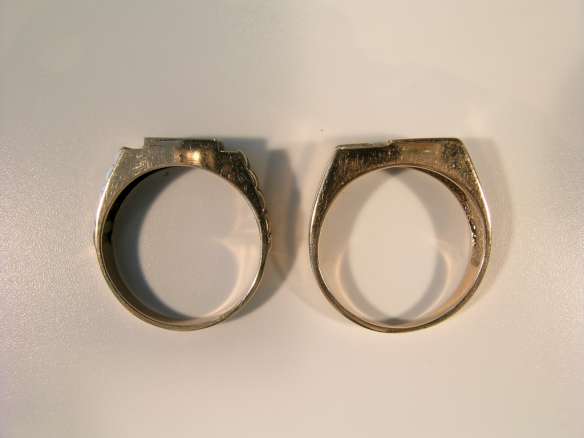
The excellence of surfaces is very often a fundamental requirement for precious items' production. Sometimes, the superficial quality is compromised by marks, opaque areas, scratches appeared on finishing phase only (see first photo).
A deeper observation carried out by using microscopes allows to evidence the fact that such kind of defects are made up of the presence of scratches even of microscopic sizes, with some particles planted onto the surfaces placed at the apex of these scratches. This phenomenon is commonly defined as comet effect. As you can notice by the following photos (see next four photos), the scratch was caused by dragging some particles (more or less pointed shape), which planted themselves onto the surface.
The morphology itself is meaningful to evidence about the real nature of the problem, but a definitive diagnosis is provided by some microanalysis carried out on the inclusions.
In the case at issue, the particles were composed by Silicon oxides which, together with Iron and Aluminium oxides, are the main constituents of abrasives commonly used for superficial finishing operations. When such steps are not successfully carried out, such as using a inadequate abrasive-metal pairing up or using low quality products, a detachment of abrasive particles may take place, which, dragged by brushes, could provoke the defect described above.
SOLUTION
The solution to the examined problem consists in paying attention to all details of finishing operations:
- Use high quality abrasives (brushes, pastes, papers);
- Use specific products as function of the kind of alloy to polish;
- Surfaces' hardening processes.